Time-adaptive teacher
Track dynamically corrected references while adapting motion phase to the target contact deadline.
The Hong Kong University of Science and Technology (Guangzhou)
ATHLETE composes generic LAFAN1 locomotion with strikes reconstructed from ordinary tennis videos into whole-body references, then distills them into one reactive policy that needs no reference motion at deployment.
From reusable motion to reactive tennis.
Humanoid tennis requires reactive whole-body coordination under rapidly changing ball dynamics, yet collecting task-specific motion-capture demonstrations that cover diverse approach states, contact locations, and timing conditions is costly. Inspired by how humans acquire new skills by combining reusable motor experience with task-specific demonstrations, we present ATHLETE, a framework for learning reactive humanoid tennis from generic locomotion data and ordinary tennis videos. ATHLETE combines LAFAN1 locomotion with video-derived striking motions and uses Trajectory-Guided Motion Matching (TGMM) to construct diverse task-conditioned whole-body references. These references are transformed into a reactive policy through physics-based teacher–student learning with online DAgger distillation, followed by PPO fine-tuning for the tennis task. The resulting policy responds directly to robot and ball observations without requiring reference-motion inputs at deployment. On a real humanoid robot, ATHLETE achieves forehand and backhand hit rates of 90.00% and 86.67%, respectively, and enables multi-shot rallies with human players. These results demonstrate the feasibility of learning dynamic humanoid sports skills from reusable locomotion experience and low-cost visual demonstrations.
Turn isolated skills into a complete approach-and-strike motion reference.
TWO MOTION SOURCES
For each sampled target ball, TGMM plans a root trajectory that satisfies strike, contact, and transition constraints. Motion matching then generates a whole-body motion reference that follows this trajectory and blends it with a striking motion reference, producing a complete approach-and-strike sequence.
Compose motion. Distill a reactive policy.
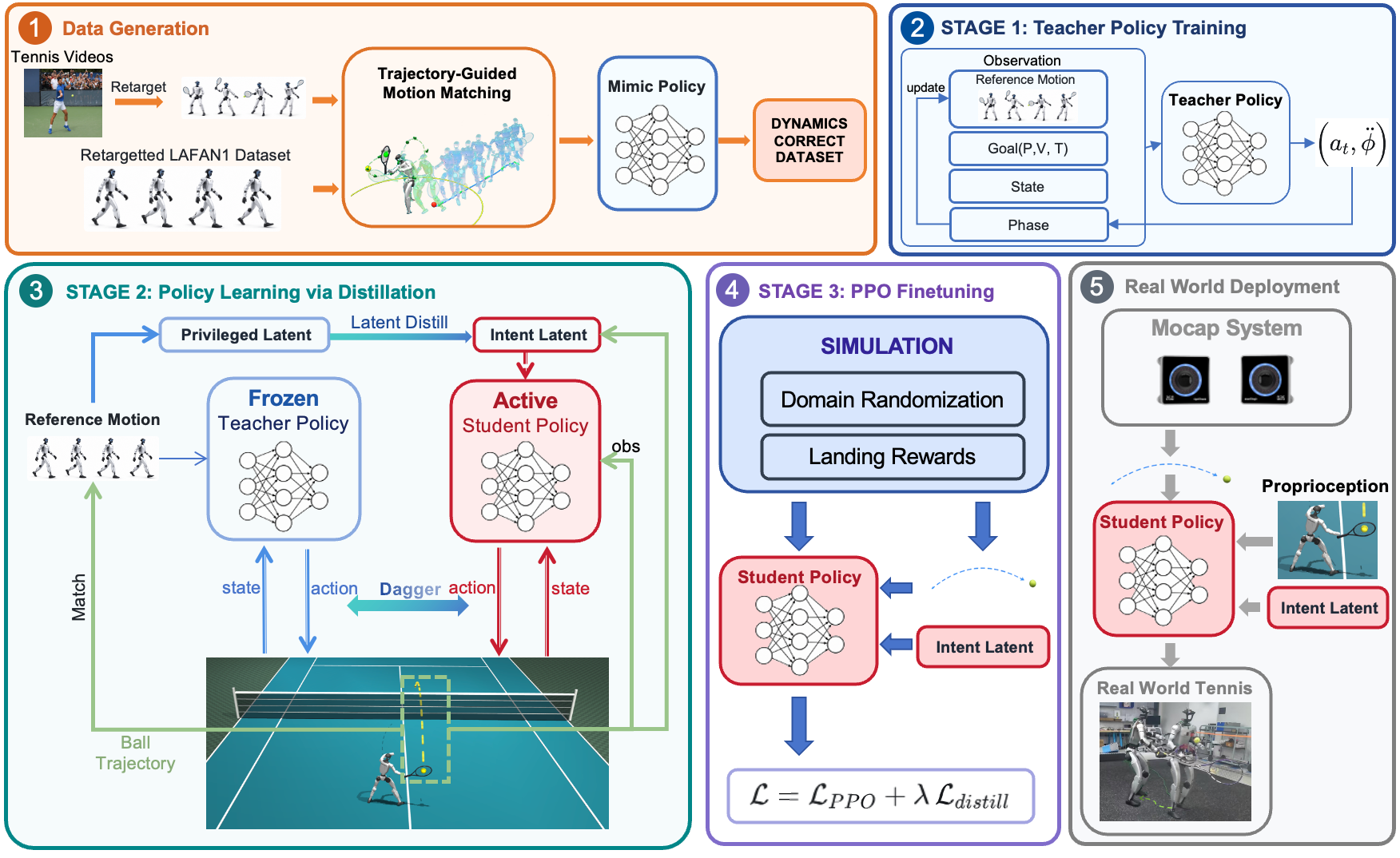
Track dynamically corrected references while adapting motion phase to the target contact deadline.
Use online DAgger and privileged representation alignment to transfer the teacher’s behavior to a policy driven by deployable observations.
Fine-tune with PPO, tennis-specific rewards, and domain randomization to improve contact precision and controlled returns.
Rally with the G1 in simulation.
Pick a landing target, serve, and watch the robot respond. The trained policy and physics simulation run entirely in your browser.
300 incoming balls: 159 forehand-side and 141 backhand-side trials.
Launch elevation: ≈37°–62° · Horizontal deviation: ≈−22°–22° · Initial ball speed: ≈5–7 m/s.
Target landing points: Gaussian sampling centered at (5, 0) m.
| Metric | Forehand | Backhand |
|---|---|---|
| Hit rate | 94.97% | 95.04% |
| Net clearance | 91.19% | 92.20% |
| Landing error | 1.150 m | 1.314 m |
| Sweet-spot distance | 5.61 cm | 6.54 cm |
Approach. Strike. Rally.
60 manually thrown balls: 30 backhand trials on the left and 30 forehand trials on the right.
Rates use all 30 trials per side. Net clearance does not imply an in-court landing.
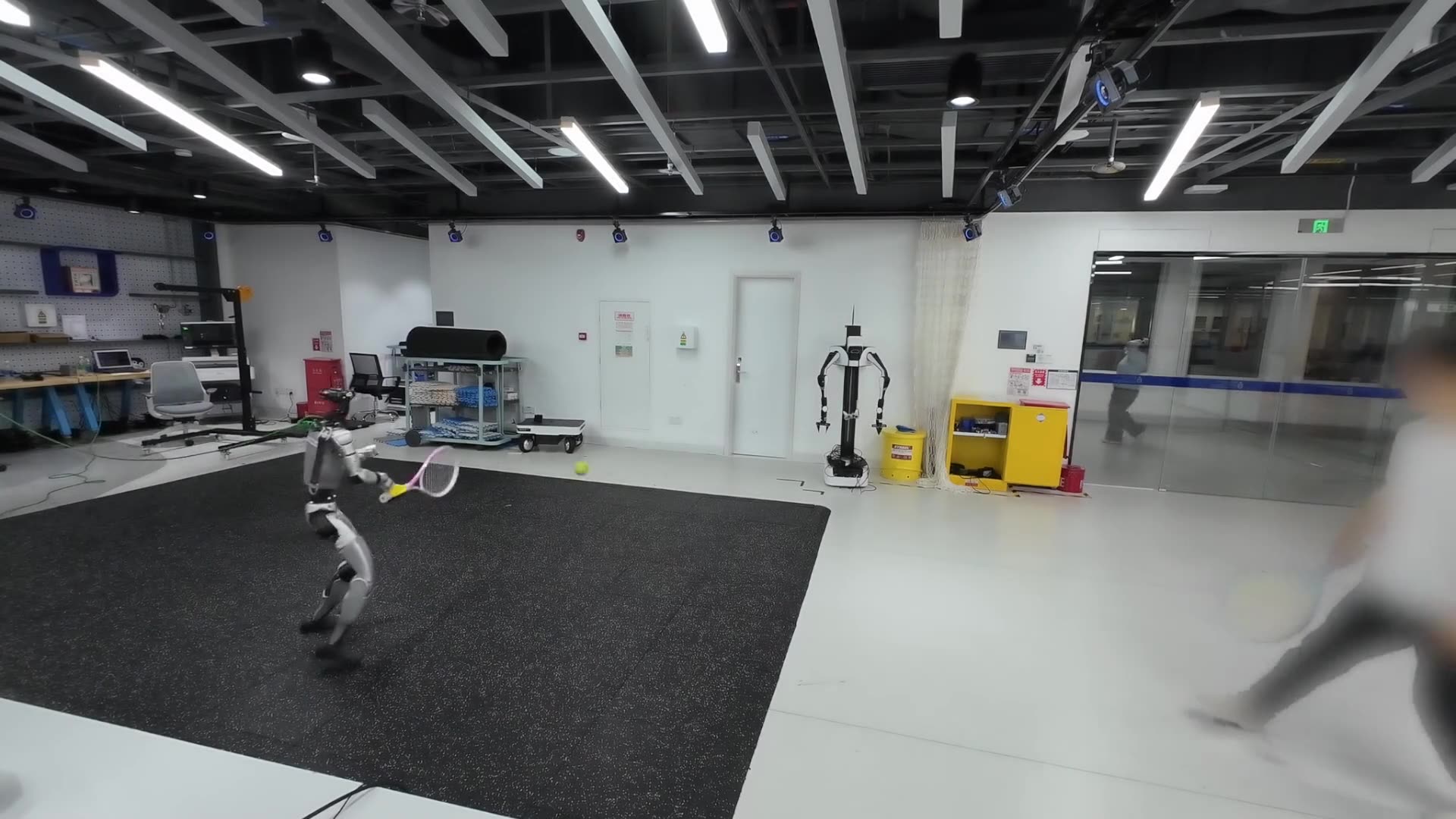
Ten additional clips show the G1 exchanging shots with human players in the lab, coordinating footwork and racket swings to respond to different incoming balls.
Real robot: 60 thrown balls, ball and root pose from external motion capture, 50 Hz control. Rates use all balls as the denominator; net clearance does not imply an in-court landing.
Simulation: 300 balls under nominal physics. Distance metrics cover struck balls only; landing error is measured at the first bounce. The browser demo is an illustration, not the evaluation protocol.