Time-adaptive teacher
Track dynamically corrected references while adapting motion phase to the target contact deadline.
01 / OVERVIEW
ATHLETE composes generic LAFAN1 locomotion with strikes reconstructed from ordinary tennis videos into whole-body references, then distills them into one reactive policy that needs no reference motion at deployment.
ABSTRACT
Humanoid tennis requires reactive whole-body coordination under rapidly changing ball dynamics, yet collecting task-specific motion-capture demonstrations that cover diverse approach states, contact locations, and timing conditions is costly. Inspired by how humans acquire new skills by combining reusable motor experience with task-specific demonstrations, we present ATHLETE, a framework for learning reactive humanoid tennis from generic locomotion data and ordinary tennis videos. ATHLETE combines LAFAN1 locomotion with video-derived striking motions and uses Trajectory-Guided Motion Matching (TGMM) to construct diverse task-conditioned whole-body references. These references are transformed into a reactive policy through physics-based teacher–student learning with online DAgger distillation, followed by PPO fine-tuning for the tennis task. The resulting policy responds directly to robot and ball observations without requiring reference-motion inputs at deployment. On a real humanoid robot, ATHLETE achieves forehand and backhand hit rates of 90.00% and 86.67%, respectively, and enables multi-shot rallies with human players. These results demonstrate the feasibility of learning dynamic humanoid sports skills from reusable locomotion experience and low-cost visual demonstrations.
TRAJECTORY-GUIDED MOTION MATCHING
For each sampled ball, TGMM plans a root trajectory to the strike under task, contact and transition constraints, follows it with locomotion clips and stitches in a matching video-derived strike. Simulated imitation rollouts then produce dynamically corrected references.
Data collection, played at 2× speed. Ghosts trace the generated motion; the yellow circle marks the 1.5 m mode boundary.
SIMULATED RALLIES
The trained policy keeps returning consecutive incoming balls in MuJoCo. Real-time playback.
02 / INTERACTIVE DEMO
Pick a landing target, serve, and watch the robot respond. The trained policy and physics simulation run entirely in your browser.
Click the court to set a target, then Space to serve. Drag the ball to throw it (Ctrl grab from anywhere, Shift move horizontally), drag empty space to orbit, R to reset.
03 / REAL-WORLD DEMONSTRATIONS
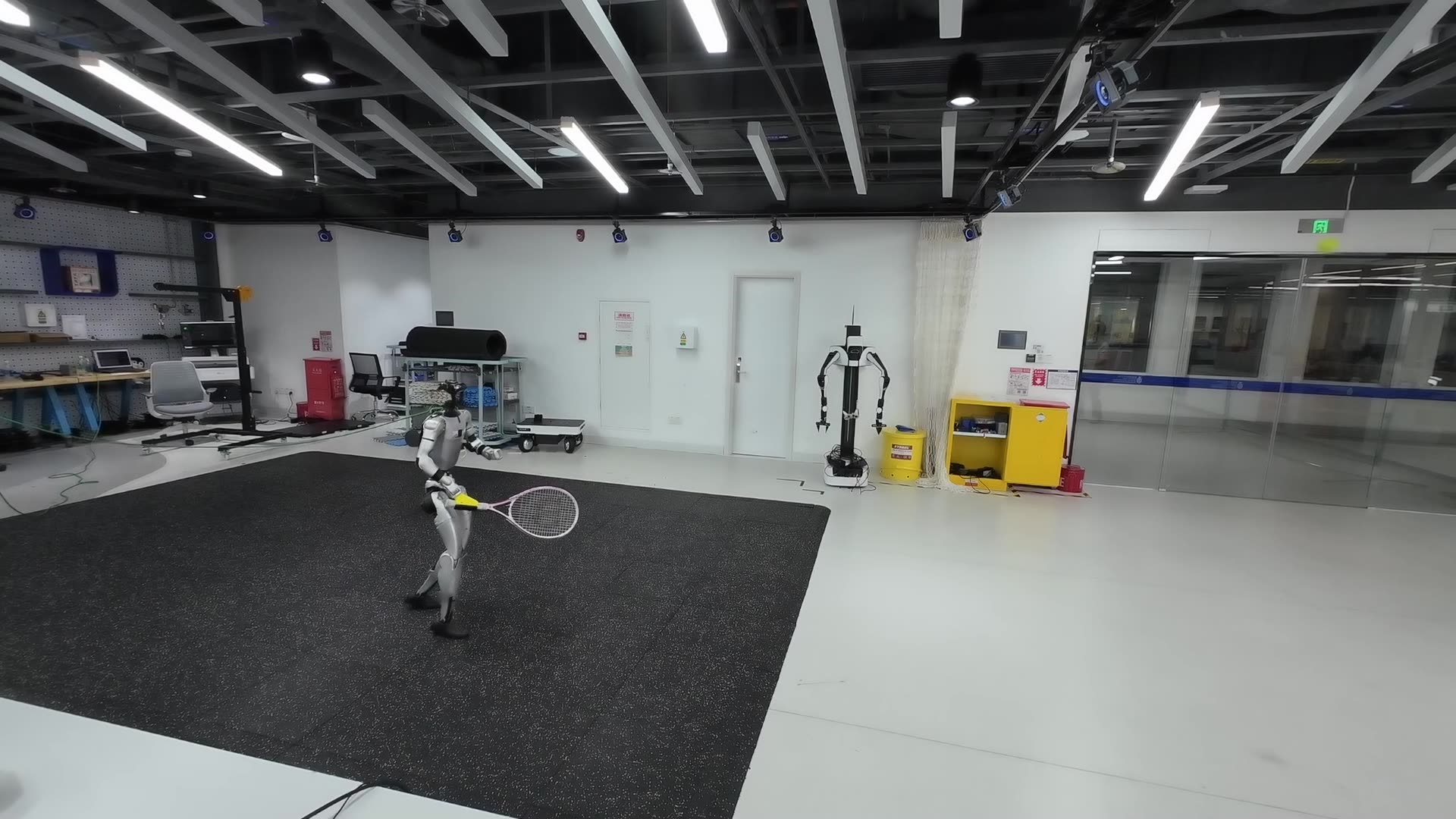
Whole-body approach and striking motions adapt to different incoming-ball locations.
All 60 trials of the real-robot single-shot evaluation (30 forehand, 30 backhand), shown as a grid.
Multi-shot rallies with novice and professional players, up to eight rounds.
04 / METHOD
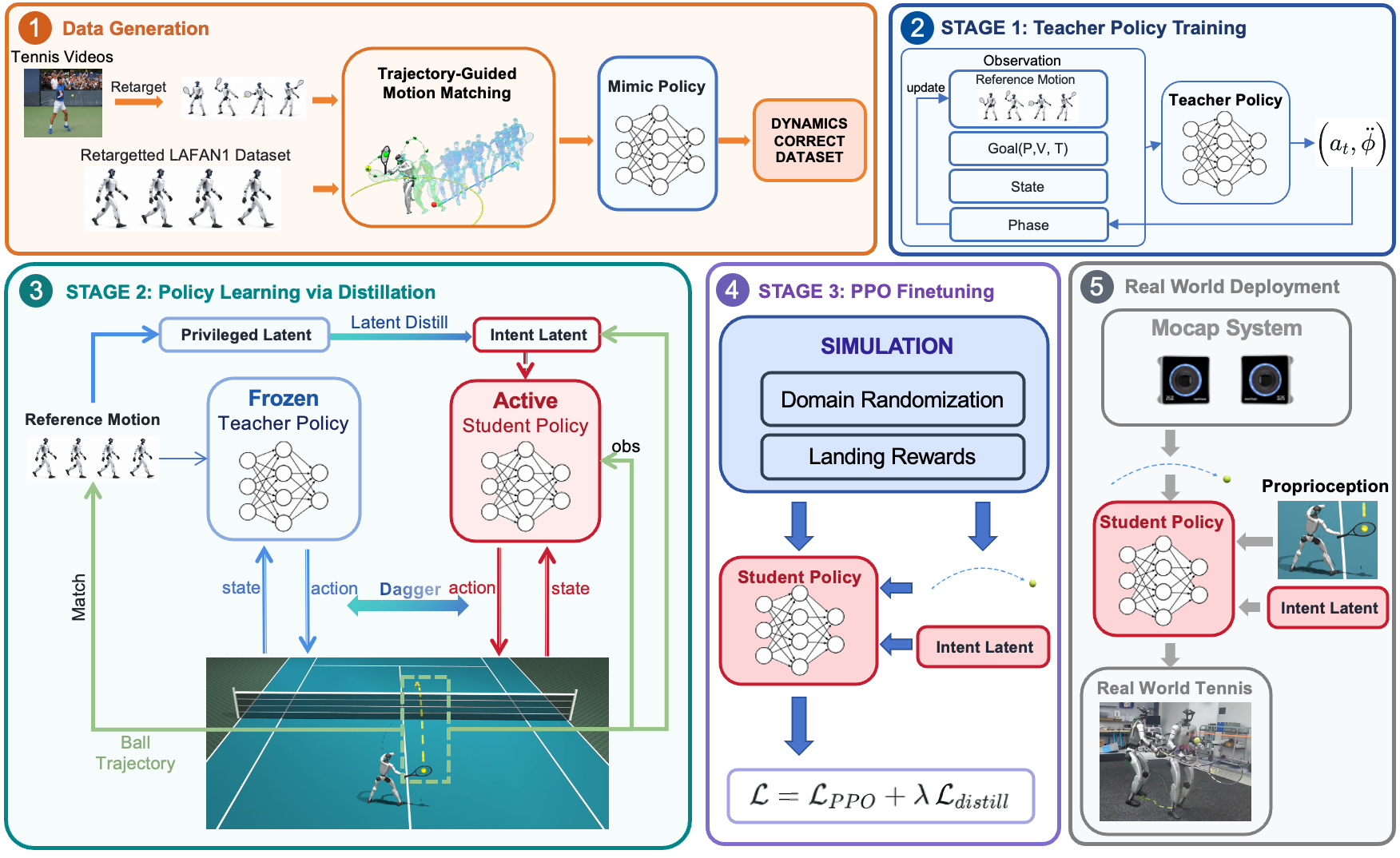
Track dynamically corrected references while adapting motion phase to the target contact deadline.
Use online DAgger and privileged representation alignment to transfer the teacher’s behavior to a policy driven by deployable observations.
Fine-tune with PPO, tennis-specific rewards, and domain randomization to improve contact precision and controlled returns.
05 / RESULTS
27 / 30 real-robot trials
26 / 30 real-robot trials
With a professional player
60 manually thrown balls, with 30 trials per side.
| Metric | Forehand | Backhand |
|---|---|---|
| Hit rate | 90.00%27 / 30 | 86.67%26 / 30 |
| Net clearance | 46.67%14 / 30 | 53.33%16 / 30 |
300 incoming balls: 159 forehand-side and 141 backhand-side trials.
| Metric | Forehand | Backhand |
|---|---|---|
| Hit rate | 94.97% | 95.04% |
| Net clearance | 91.19% | 92.20% |
| Landing error | 1.150 m | 1.314 m |
| Sweet-spot distance | 5.61 cm | 6.54 cm |
Real robot: 60 thrown balls, ball and root pose from external motion capture, 50 Hz control. Rates use all balls as the denominator; net clearance does not imply an in-court landing.
Simulation: 300 balls under nominal physics. Distance metrics cover struck balls only; landing error is measured at the first bounce. The browser demo is an illustration, not the evaluation protocol.